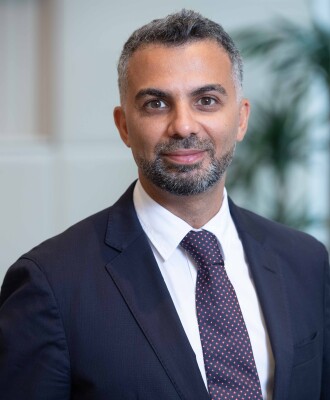
Mr Ahmed Ali is a Consultant Urological Surgeon and bladder cancer lead, specialising in advanced bladder cancer diagnosis and treatment, prostate MRI diagnostics and benign urology.
Mr Ahmed Ali is a Consultant Urological Surgeon. He specialises in the diagnosis and treatment of bladder and prostate cancer, using advanced techniques such as blue-light cystoscopy and MRI-based prostate diagnostics, and he also treats benign urological conditions. He is a Consultant Urologist with Urology Partners and has been a consultant at Frimley Health NHS Foundation Trust since 2017.
Bladder cancer
Mr Ali leads the bladder cancer service at Frimley Park Hospital. He has introduced several advanced techniques that improve precision and safety in bladder cancer diagnosis and treatment:
- En-bloc bladder tumour resection, which removes a tumour in a single piece
- Narrowband imaging, which highlights abnormal tissue during cystoscopy
- Blue-light cystoscopy, which helps identify tumours that are difficult to see under white light
Prostate cancer and MRI diagnosis
Mr Ali completed a fellowship at Addenbrooke’s Hospital in Cambridge, where he trained in MRI-based diagnosis of prostate cancer, now a cornerstone of modern prostate cancer assessment.
General and benign urology
Mr Ali’s practice covers a wide range of conditions, including:
- Benign prostatic enlargement (BPH)
- Kidney stones
- Testicular cancer
- Urinary tract infections
- Urinary incontinence
- Functional bladder disorders, including overactive bladder
He combines evidence-based medicine, advanced technology and compassionate care to give every patient a personalised approach.
research and professional leadership
- Chief Investigator and Clinical Collaborator on an NIHR-funded trial of novel biomarkers in overactive bladder syndrome
- Founder of the Arab British Urological Society, which promotes professional development, medical education and international collaboration
Qualifications and training
- Medical degree, University of Baghdad (2005)
- Moved to the UK in 2007 for higher surgical training
- Master’s degree in Urology, University College London (2013)
- Fellowship in MRI-based prostate cancer diagnosis, Addenbrooke’s Hospital, Cambridge
- Consultant Urological Surgeon, Frimley Health NHS Foundation Trust, since 2017
Frequently asked questions
What does Mr Ahmed Ali specialise in?
He specialises in bladder cancer, prostate cancer diagnosis using MRI, and benign urology including prostate enlargement, kidney stones, UTIs and incontinence.
Does Mr Ali treat bladder cancer?
Yes. He leads the bladder cancer service at Frimley Park Hospital and uses advanced techniques including en-bloc tumour resection, narrowband imaging and blue-light cystoscopy.
What is blue-light cystoscopy?
It is a type of bladder examination that uses a special light and dye to highlight tumours that may be hard to see under normal light. It helps surgeons find and remove bladder cancer more completely.
What is MRI-based prostate cancer diagnosis?
It uses an MRI scan to find suspicious areas in the prostate before a biopsy, so the biopsy can be targeted more accurately. Mr Ali trained in this approach at Addenbrooke’s Hospital.
Does Mr Ali treat overactive bladder?
Yes. He treats functional bladder disorders and is Chief Investigator on an NIHR-funded trial of biomarkers in overactive bladder syndrome.